
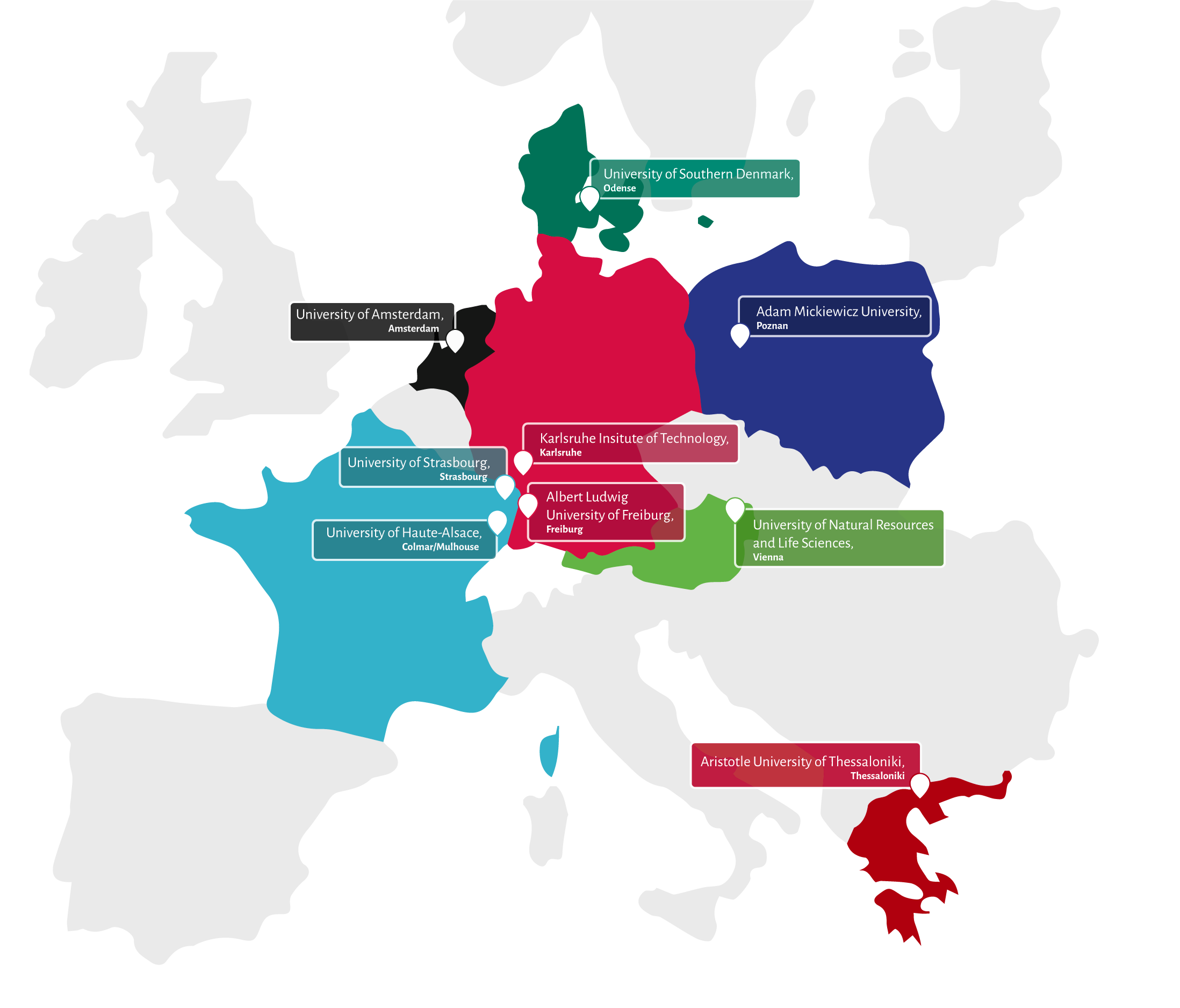
The EPICUR alliance aims to create an attractive, innovative European university for a new generation of students in Europe. It is made up of the following universities:
- Adam Mickiewicz University in Poznan (Poland)
- University of Amsterdam (Netherlands)
- Aristotle University in Thessaloniki (Greece)
- Albert-Ludwigs-University of Freiburg (Germany)
- University of Upper Alsace (France)
- Karlsruhe Institute of Technology, KIT (Germany)
- University of Southern Denmark (Denmark)
- University of Natural Resources and Life Sciences, Vienna (Austria)
What does the EPICUR Alliance offer students?
As part of the EPICUR Alliance, the participating universities offer a wide range of lectures, seminars and workshops in the areas of research, teaching and innovation. Stronger interdisciplinary networking between the EPICUR partners is planned, particularly in research and innovation. Every student who is enrolled at one of these universities can select courses from all courses available to EPICUR students at the other seven partner universities in addition to the courses offered by their own university.
This means that, as a KIT student, it is possible to attend a lecture at the University of Amsterdam, for example, in addition to courses offered by your own faculty. In this case, participation takes place via the virtual EPICUR campus in the form of digital teaching formats.
In future, the KIT Lecture Translator will also be used, which allows lectures to be viewed in other languages with corresponding German, English or other language subtitles.
If you are already a little further along in your studies and would prefer to gain practical experience in another country, you can apply for a virtual internship with start-ups or larger companies abroad.
What advantages does the EPICUR alliance offer?
- Receipt of a certificate with verified completion of the course(s) attended
- Networking with international students from European universities
- "Get a taste" of teaching formats in other countries
- Enlargement of the range of courses offered through events outside the KIT
- Improvement of language skills through participation in non-German courses (possibly with subtitles)
- Easy and free participation through digital courses
- No upper limit on the number of courses attended
- Unbureaucratic process - simple application using appropriate verification documents to qualify for courses with a limited number of participants
Further information: